

From Treasure Vacation Rentals, a locally owned property-management company on Topsail Island, North Carolina. Last reviewed September 2026.
Here is a question we get from owners more than any other, in one form or another: why do two perfectly good homes on the same island need completely different pricing decisions for the same week?
The honest answer is that there is no single seasonal rate curve that fits every Topsail Island home. The right rate depends on how big the home is and what it offers, what season it is, how many similar homes are still open, how strong demand is right now, how fast the home is booking compared with normal, and, maybe most important, when the guests who book that kind of home usually make up their minds. A rate that makes complete sense in February can be too ambitious by July. The home did not change. The people who book that kind of home mostly finished shopping.
That last idea is the one we want to spend some time on, because it explains a lot of what owners see on their calendars and do not always get a good explanation for. We will walk through it using three things: Treasure’s own anonymized booking history going back to 2005, public advertised-rate data for Topsail Island homes, and a candid look at two homes in our program that came to us this summer after their natural booking window had mostly closed. Along the way we will pin down a few terms that get tangled together, and we will finish with what all of this means in practice for owners, and separately for guests.
In this article
A few terms worth getting straight
Most pricing arguments go sideways because two people are using the same word for different things. So, briefly, here is how we use these.
Booking window, or lead time, is simply the number of days between when a guest books and when they arrive. Book on January 10 for a July 10 arrival and your booking window is 181 days.
Booking pace is how fast a home is filling for a future period compared with how it usually fills, or compared with similar homes. It is about the trend, not a single snapshot. A home half booked for July in March may be right on pace. The same home half booked for July in late June is probably behind.
Asking rate, or advertised rate, is what the listing shows for a date that is still open. It is what the owner or manager hopes to get. It is not proof that anyone paid it.
Booked rent is what a guest actually paid for a reserved stay. This is the only rate that turns into owner income.
Occupancy is the share of available nights that actually booked. It tells you how full, not at what price.
ADR, average daily rate, is total rental revenue divided by booked nights. It tells you at what price, not how full.
RevPAR, revenue per available rental, is rental revenue divided by all available nights, booked or not. Since it combines occupancy and rate, it is the most honest single number for comparing pricing strategies. A high rate with weak occupancy and a modest rate with strong occupancy can land on the same RevPAR.
Asking capacity is our own shorthand for what a full calendar of advertised rates represents: the most a home could possibly earn if every single night sold at the listed price. It is a ceiling, not a forecast.
Why bother with all that? Because a public rate calendar shows asking capacity, a reservation report shows booked rent, and a market benchmark shows occupancy, ADR, and RevPAR across a panel of homes. They are related, but they are not the same thing, and we will keep them separate here.
The shape of the season depends on the size of the home
If you look at advertised weekly rates across Topsail Island, you might expect bigger homes to follow the same seasonal curve as smaller ones, just at higher dollar amounts. They do not. The shape itself changes with bedroom count.
We track publicly advertised weekly rates for Topsail Island rentals as part of our market work. In a July 2026 review of that data, we grouped homes by bedroom count and expressed each home’s weekly asking rate as a share of its own peak-week rate. That lets a small cottage and a big oceanfront house sit on the same chart without the dollar figures hiding the pattern.
The pattern was consistent. One- and two-bedroom homes held on to roughly half of their peak asking rate through much of the off-season. Three- and four-bedroom homes dropped a bit more steeply through the shoulder and off-season. Five- and six-bedroom homes fell more sharply outside summer. And homes with seven or more bedrooms showed the steepest seasonal spread of all, with many spring and fall weeks advertised at roughly a third to two-fifths of peak, depending on the week and where the home sits.
Two caveats travel with that. These are advertised prices on inventory that was still open when we looked. They are not achieved rent, occupancy, or owner revenue, and they are not a recommendation for any particular home. And they are a provisional July 2026 baseline. That is why we describe the directional pattern here instead of publishing a precise week-by-week percentage series.
Why do the biggest homes fall so far outside summer? The public data cannot tell us why, and we are not going to guess. What it does tell us is that the market prices large homes as strongly seasonal. That is the first clue that the guest who books a ten-bedroom house behaves differently from the guest who books a two-bedroom condo.
Bigger homes have always booked earlier
The second clue comes from our own history.
Treasure’s founders previously managed vacation homes on Topsail Island through Treasure Realty, and Treasure holds an anonymized reservation export covering arrivals from 2005 through 2021. To study lead time, we used only bedroom count, reservation status, arrival date, stay length, reservation date, and booked rent. No guest names, contact details, or anything of the kind.
We narrowed it to a clean group: checked-out reservations of exactly seven nights, arriving in 2005 through 2021, with positive booked rent, a bedroom count from 1 through 20, and a believable lead time of 0 through 730 days. That leaves 107,864 completed seven-night stays.
For this analysis, prime season is June 15 through August 14. Shoulder season is April 1 through June 14 and August 15 through October 31. Everything else is off-season.
Days from reservation to arrival; axis starts at zero.
| Home size | Prime-season stays in cohort | Median prime-season lead time | Middle 50% of prime bookings | Median shoulder-season lead time | Median off-season lead time |
|---|---|---|---|---|---|
| 1–2 bedrooms | 13,411 | 71 days | 30–133 days | 58 days | 22 days |
| 3–4 bedrooms | 19,530 | 136 days | 73–182 days | 96 days | 42 days |
| 5–6 bedrooms | 12,666 | 174 days | 127–248 days | 131 days | 57 days |
| 7+ bedrooms | 4,343 | 232 days | 157–347 days | 210 days | 105 days |
Source: Treasure’s anonymized historical reservation export, arrivals 2005–2021, completed seven-night stays only. Lead time is days from reservation date to arrival. These are medians of a historical group, not forecasts.
Read across any row and you see the seasonal pattern: prime weeks booked earliest, shoulder weeks next, off-season weeks last. Read down the prime-season column and you see the size pattern. The median lead time for a seven-plus-bedroom home was more than three times the median for a one- or two-bedroom. Half of all prime-season bookings for the largest homes were made somewhere between about five months and eleven and a half months before arrival.
We checked whether that held up across different stretches of time. Looking only at 2005 through 2019, only at 2017 through 2019, and only at the pandemic years of 2020 and 2021, the order never changed: prime booked earlier than shoulder, shoulder earlier than off-season. The exact medians moved around, and seventeen years is a long time in how people travel, so treat the table as a strong historical pattern rather than a rule.
And be clear about what the table does not say. It does not say 2026 or 2027 guests will book on this timeline. It does not say a big home cannot book late. Plenty did, which is why the middle range for the largest homes reaches down to 157 days. What it does say is that the natural planning horizon for a big-group beach week has historically been long, and anyone pricing a large home should plan around that.
This is not a Topsail quirk. KeyData, a vacation-rental analytics company whose public articles we cite here for industry context rather than as proof of anything Topsail-specific, has written about both halves of it. Their KPI guide notes that summer stays book much further ahead than spring and fall stays, and that the booking window depends on unit type, stay length, party size, season, and destination. Their look back at August 2024 in the U.S. puts the size point in a single line: "Bookings made earlier tend to be for larger units at higher prices." And in a separate piece on summer destinations, KeyData reported a prior-year summer booking window of about 180 days for North Carolina’s Outer Banks. Different market, different inventory, different guest mix, so take it as a nearby reference point and nothing more.
Revenue managers well outside the beach world describe the same thing. Back in 2019, Heather Richer of RedAwning wrote in VRM Intel that pricing strategy may need to differ by unit type, contrasting a studio that books within a few weeks of arrival with homes of eight or more bedrooms whose booking curve may run three to four months, after which they get harder to fill. That was an urban, event-driven example, and the Topsail medians above run longer still. The principle is the same: the bigger the home, the earlier its guests decide, and the less forgiving the calendar once they have.
Now, you may have read that booking windows are shrinking, and that is true as far as it goes. Industry reporting through 2025 and 2026 has consistently described windows getting shorter across U.S. markets, with a growing share of reservations made inside a week of arrival. Rental Scale-Up’s 2026 planning guide, citing PriceLabs data, put last-minute bookings at about a quarter of U.S. reservations by 2025, up from about a fifth in 2022. But The Host Report, summarizing AirDNA data in June 2025, noted that luxury travelers were the exception, with long-lead bookings in that segment growing while budget-segment long-lead bookings shrank. And AirDNA’s own economists, in a June 2026 STR Data Lab episode carried by VRM Intel, said larger and premium homes were continuing to outperform. So if a manager reads "windows are shrinking" and applies it to a ten-bedroom oceanfront house, they are applying the market average to the one segment where it fits worst. The big-home audience still plans early. The shrinking-window story is mostly about smaller homes and gap nights.
We can see a small version of this in our own books right now. As of early September 2026, a handful of paid reservations for 2027 arrivals across Treasure’s homes were already in, most of them seven-night stays, with a median lead time of roughly eleven months. That is a small, early-booking sample from one portfolio, so we offer it as an observation, not a market finding. But it lines up with the history: some guests plan a prime Topsail week close to a year out.
Booking pace: the same rate can be right in February and wrong in July
Put those two findings together and the practical lesson follows.
If the typical prime-season guest for a seven-plus-bedroom home historically booked about 232 days out, then by the time a July week is 90 days away, well over half of that home’s natural audience has usually already booked somewhere. A rate that was competitive in December is now being shown to a much smaller group of late planners, and late planners tend to be shopping across more homes and more dates than the early ones were.
That is what booking pace is really measuring. The question is not just "is this rate fair for this home?" It is "is this rate fair for this home, given how many of the people who normally book it are still out there looking?" A good manager checks pace against the home’s own history and against comparable homes, and treats a slowing pace as a reason to look at the rate before the window closes, not after.
The opposite mistake is just as common, and worth naming so nobody overcorrects. A quiet week in January is not a problem for a home whose guests normally book in March. KeyData’s public guidance on pickup and booking windows and on shoulder-season pricing makes this case well. A shorter booking window in one year does not by itself mean demand is weaker; it can mean demand is showing up later. Cutting a rate before the market’s normal buying period opens does not capture demand, it discounts ahead of it. And the fair comparison is current pace against the same point in prior years, not against a gut feeling that the dashboard looks quiet. The same guidance suggests setting rate boundaries ahead of time and letting recent pickup guide moves inside them, and starting with weekday rates, which are usually more price-sensitive, before touching weekends.
So it cuts both ways. Do not panic-discount a home whose audience has not arrived yet. Do not sit on a rate for a home whose audience has already left. Telling those two apart requires knowing the home’s normal window, which is exactly why the table above earns its place.
Amber Knight of BookingsCloud put a useful frame on this in VRM Intel in June 2026. Her point is that pacing reports tell you a home is behind, but not how much revenue is still realistically within reach before the window closes. A home behind pace 45 days out is in a completely different spot from one behind pace a week out. At 45 days there is still time to build visibility and protect rate. At seven days, price is usually the only lever left. Pricing pressure, as she puts it, is the final stage, not the first response. Other operators say much the same thing in practice: Rental Scale-Up recommends tracking occupancy at fixed lead times, say 30, 60, and 100 days out, against the same point last year, and Jasper Ribbers, writing for VRMA Arrival, recommends small, deliberate weekly adjustments guided by pace and pickup rather than one big late one.
Dynamic pricing software helps with all of this. It takes a base price and layers on seasonality, local demand, availability, time to arrival, and the limits the owner sets, then updates its recommendation as conditions change. KeyData’s writing on revenue strategy makes a point we agree with: the tools work best when they are grounded in a full picture of the market rather than assumptions or a quick glance at a couple of competitors. For us that means pairing the software with our own Topsail data and a person who knows the island, checks the tool’s assumptions, and notices when a recommendation does not fit a particular house.
That matters most for the big and premium homes. KeyData’s article on pricing luxury portfolios argues that those homes should not be priced against the broad market average at all, but against a tightly filtered peer group matched on bedroom count, location, amenities, and rate tier, watching how fast the home books rather than only where occupancy ends up. On an island where ten-bedroom oceanfront homes are a small slice of the inventory, that peer group is small, and knowing it personally is part of the job.
Late August thins the crowd fast, and it does every year
There is one more piece of timing that matters if you are pricing a Topsail home in late summer.
Every year, the family audience for beach weeks shrinks as August winds down. Schools start back, summer schedules close, and the number of households who can take a seven-night beach week in late August or September gets a lot smaller than it was in July. Nobody who has spent a summer here needs to be told that, and it is not a 2026 thing. Because it happens every year, it should already be built into a home’s seasonal plan. It also cannot, on its own, explain why any particular year lands where it does.
In 2026, though, the drop was a good deal steeper than usual. We compared KeyData’s Market Benchmarking data for the Topsail Island market across four years, reading each year at the same point on the calendar, roughly the first week of September, so 2026’s on-the-books position was measured against where 2023, 2024, and 2025 stood at that same moment, not against their finished totals. Through the first three weeks of August, 2026 ran a few points behind the earlier years. Then it kept sliding when the earlier years had leveled off. By the last week of August, adjusted paid occupancy for the market was 36.5% in 2026, against roughly 50% to 54% in the same week of each of the three prior years, a gap of about fourteen to seventeen percentage points.
Three things about that week tell us it was a volume problem, not a rate problem. The market’s average daily rate was higher than in any of the three prior years, so rates had not been slashed, yet revenue per available night was well below all three because so many fewer guest nights sold. Available inventory was about flat with 2025 and above the two earlier years, while owner and hold nights were lower than in all three, so the weak number is not the result of a smaller or blocked-off denominator. And the guests who did come that week had booked noticeably closer to arrival and stayed fewer nights than the comparable guests in prior years. In plain terms, more bookable nights were chasing fewer families, and the families who came decided later and stayed shorter.
A word on what that number is and is not. Adjusted paid occupancy is an outcome. It is guest nights measured against available inventory after KeyData’s adjustments for owner and hold nights. It is not a count of how many people were searching, and a four-year comparison of one week cannot prove a single cause. Cancellations that week were somewhat elevated, but not by enough to explain the gap on their own. We are comfortable saying the late-August 2026 shortfall was unusually deep and materially below the prior three years. We are not going to name a cause we cannot support. And the September weeks we looked at on September 3 were still future arrival weeks, so those readings showed what was on the books at the time, not final occupancy, and they are not part of this comparison.
The broader industry picture offers some context without settling anything about Topsail. KeyData’s review of August 2024 described a U.S. summer in which occupancy slipped as supply outgrew demand, with softness carrying into September before later fall weeks paced ahead. Their 2026 trends article describes shoulder seasons strengthening and booking windows lengthening in smaller destinations. A June 2026 summer pacing update on VRMA Arrival, drawing on KeyData market data, described a 2026 summer where revenue growth came more from rate than occupancy, with windows compressing and results varying a lot between coastal markets, some well ahead of the prior year and some, including parts of the Carolina coast, running behind on occupancy. These are national or multi-market observations, not Topsail measurements, and none of them tells us what happened on this island in the last two weeks of August.
What the recurring pattern does support is a bounded, useful conclusion. The late-August transition reliably shrinks the audience for late-summer weeks. An owner whose home came to market late, or whose rate never moved while the audience was still big, has far fewer prospects left to reach by the end of August than at the start. That is the whole argument for getting into the market early and responding to pace before the window closes, because the window closes on a schedule that does not move much from one year to the next. And in a year like 2026, when the late-summer crowd turned out to be thinner than usual, the homes that had been positioned and priced months earlier were the ones with the least left to make up.
Two homes that show exactly how this works: Ocean Chateau and Topsail Sanctuary
We would rather explain this with real houses than hypotheticals, so here are two of ours.
Ocean Chateau at 4234 Island Drive and Topsail Sanctuary at 3072 Island Drive are both newly built ten-bedroom oceanfront homes in North Topsail Beach. They are exactly what a multi-family group or a big reunion goes looking for. Both joined the Treasure program in mid-July 2026.
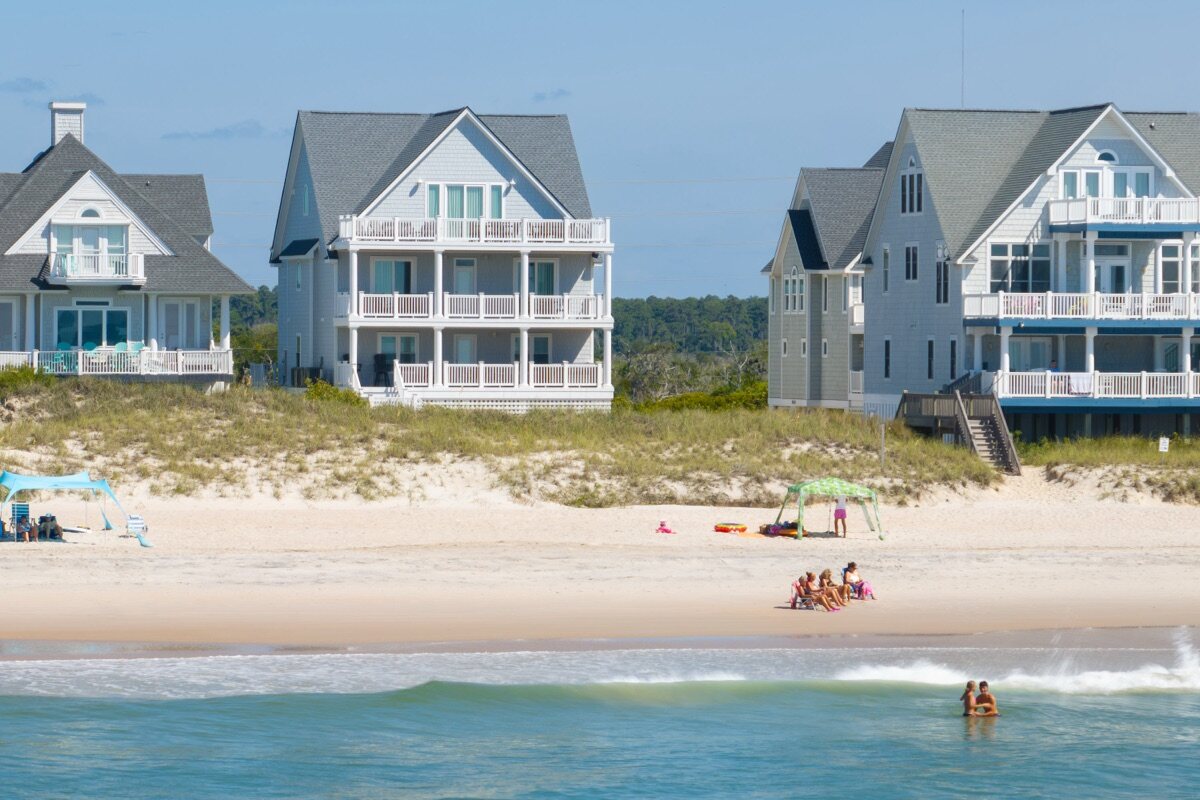
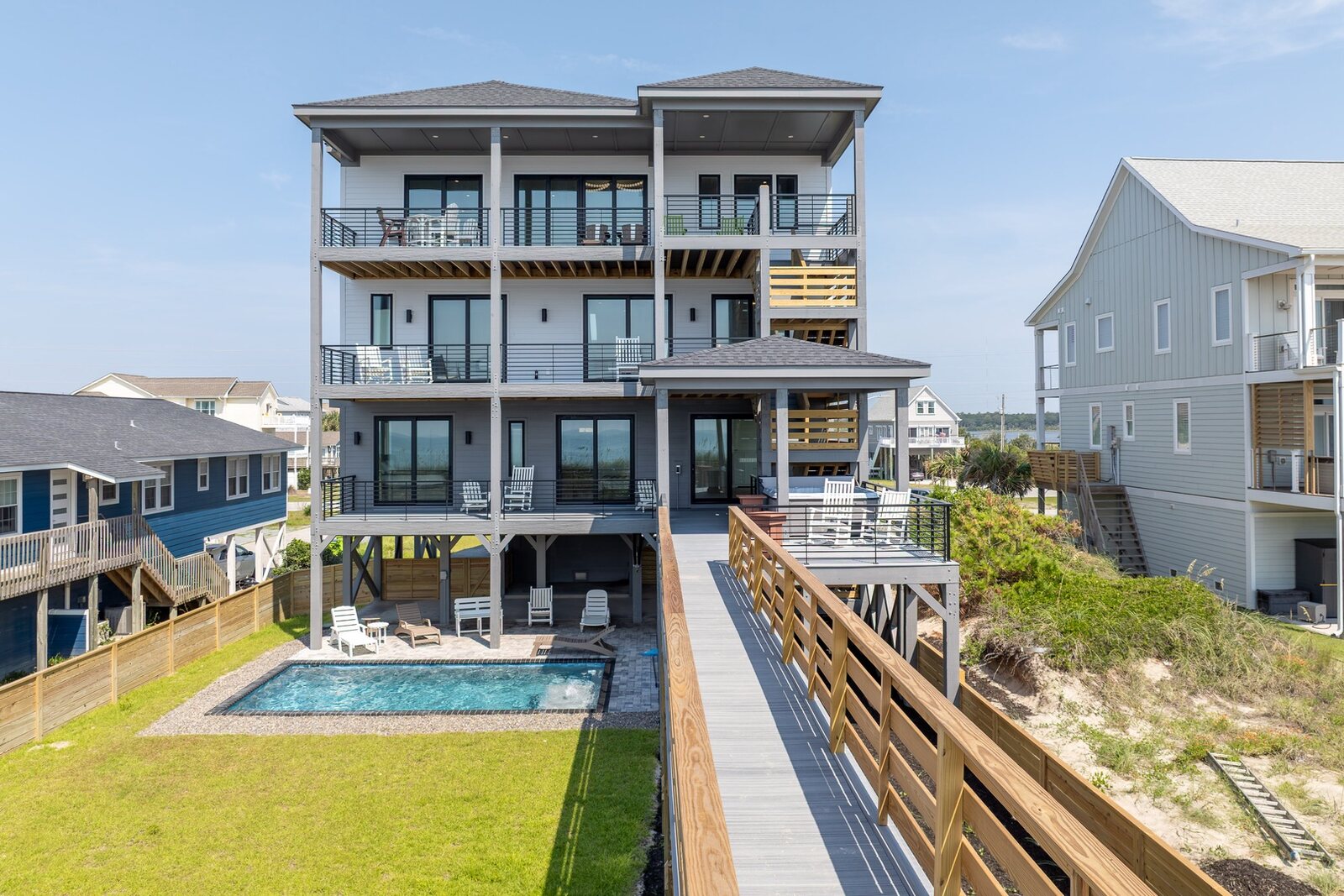
Here is the timing problem, plainly. Look back at the table. The typical prime-season guest for a home this size booked about 232 days ahead, and shoulder-season guests for big homes booked with a median of about 210 days of lead time. When these two homes came to us in mid-July, their fall 2026 calendars were still largely open. The previous management had not booked the fall, and by then much of the natural audience for a big late-summer or fall oceanfront home had committed to other plans months earlier. Treasure did not control that advance-booking period. We received the homes after it had mostly passed.
None of that reflects on the houses. They are new, they are on the ocean, and they sleep the kind of group that has very few options on this island. It is not a story about how Treasure managed them, either. The months when homes like these are normally positioned, marketed, and booked had already come and gone. And it happened to land in the unusually thin late-August market described above, which meant the late-booking audience we could still reach was smaller than in a normal year, and those guests were deciding later and staying shorter. This is what launch-window risk looks like: an excellent home can still need a serious price adjustment if it enters the market after the people who usually book it have already made their plans.
So we did what a manager should do in that spot. We substantially reduced the remaining 2026 rates on Ocean Chateau and paired that with a published promotional offer, and we reduced the remaining 2026 rates on Topsail Sanctuary, which the listing now says plainly. Same goal both times: compete honestly for the smaller late-booking audience instead of holding a rate built for an audience that had already moved on. We are not going to publish property-level rate grids, occupancy, or booking totals, because those belong to the owners, and because a rate on a listing page is an asking rate, not a promise of what any given week will bring.
The lesson for owners is really the point of this whole article. Good management of a home like this starts many months before anyone arrives. It means 2027 rates released and visible while big-group planners are looking. It means pricing those rates against real demand for large oceanfront homes rather than a formula. It means watching pace through the winter and spring and adjusting while there are still enough prospective guests to respond. Both of these homes will have that full runway for 2027.
The lesson for guests is simpler. If you have a big group that can travel this fall, the timing has created an unusual value opportunity on two brand-new oceanfront homes. Current availability and rates are on each listing page.
What good management looks like across the booking window
Whether it is a two-bedroom cottage or a ten-bedroom oceanfront house, the process looks about the same. The timing and the numbers change. The discipline does not.
Well before the window opens, set a baseline rate for each season from the home’s features, its location, and comparable homes that actually booked, not just the ones still sitting on the market advertising. Make sure next year’s rates are released and bookable early enough for the home’s audience; for a large home, that means well before the winter planning season. And set floors and ceilings so a pricing tool cannot drift somewhere the owner would never accept.
As the window opens, watch pace against the home’s own history and its peers. Look at far-future weeks, not just next month. Note holidays and local events and decide on purpose how to price around them rather than letting the calendar surprise you.
As the window narrows, and pace slows relative to the same point in prior years, review the rate while the audience is still large. Small, early moves usually cost less than one big late one. But confirm the slowdown is real first. If comparable homes are pacing the same way and the home’s normal buying period has not opened yet, holding may be the right call. And check the total guest price, fees and taxes included, because that is the number a guest actually compares.
After the window closes, judge the season by booked rent, occupancy, and RevPAR, not by asking rates, and feed what you learned back into next year’s baseline.
At Treasure, we run a dynamic pricing tool alongside our own Topsail data and human review at every one of those stages. The software is good at math. The judgment about whether a recommendation actually fits a particular house on a particular street is the part we take responsibility for.
A short checklist for owners
If you want the practical version, here it is.
- Know your home’s audience and how far ahead they plan. Bigger homes historically booked much earlier for prime weeks, so plan release dates and rate reviews around that horizon, not the calendar month.
- Get next year’s rates out early enough to be seen. A rate that is not published cannot be booked, and for a large home, unreleased winter rates can mean missing the guests who plan furthest ahead.
- Build the baseline from comparable homes that actually booked. Treat advertised rates on still-open inventory as a ceiling, not a target.
- Set floors and ceilings so any automated tool works inside limits you chose.
- Watch pace, not just occupancy. Is the home filling at its normal speed for this point in the year, compared with prior years and with similar homes? Recent pickup tells you more about momentum than one occupancy number.
- Review far-future weeks on a schedule, especially prime season for large homes, where the window opens earliest.
- Price holidays and local events deliberately instead of discovering them after they book, or do not.
- Adjust while the audience is still large, but not before it shows up. A slowing pace means act early, when a modest change reaches a lot of people. Discounting before the home’s normal buying period opens just gives away rate to guests who were going to book anyway.
- Plan for the late-August contraction every year. It is predictable. Price late-summer and early-fall weeks with it in mind from the start rather than reacting in the last week of August.
- Check the total guest price your listing shows, cleaning fees and taxes included. That is what guests compare.
- Judge the season by booked rent, occupancy, and RevPAR, and let that shape next year’s plan.
If you are a guest, here is what this means for you
Rates move with timing, not just the calendar. A home listed at one price in January and another in July has not become a different house; the crowd shopping for it has changed. Large homes are the most seasonal of all, and if you are planning a multi-family week in a big oceanfront home for prime summer, the history says those weeks booked earliest, often many months out, so planning early gives you the best choice. Late-season and fall weeks can be a real value, especially in the largest homes, where advertised rates historically fell furthest outside peak summer. Always compare the total price rather than the nightly rate, since fees and taxes vary between listings. And if the week you want looks out of reach, just ask. A local manager can often tell you whether a nearby week or a similar home fits better. We answer the phone.
Questions owners ask us
Is there really a "cheapest" time to rent on Topsail Island?
Broadly, yes. Advertised rates are lowest outside the June-through-mid-August peak, and fall, winter, and early spring run well below summer. The gap is widest for the biggest homes. Exact rates vary by home and by week, so the listing is the place to check for your dates.
How far ahead do guests actually book a Topsail beach house?
It depends on the size of the home. In our historical records of completed seven-night stays from 2005 through 2021, the median prime-season booking was made about 71 days ahead for one- and two-bedroom homes and about 232 days ahead for homes with seven or more bedrooms. Those are historical medians, not rules, but they say large groups have the most to gain from planning early.
Why did my home’s rate change after a guest looked at it?
Because rates are increasingly adjusted as demand, remaining availability, and time to arrival change. A rate can come down if a home is booking slower than usual for that point in the year, and it can go up if demand for that week strengthens.
What is dynamic pricing, in plain terms?
It is adjusting a nightly rate over time based on season, local demand, availability, and how far off the arrival date is, usually with software doing the heavy lifting. Done well, it combines that software with market data, owner-set limits, and a person reviewing the results.
My listing shows a high rate. Why is my income not matching it?
Because an advertised rate is an asking price for a date that has not booked yet. Income depends on which nights actually book and at what price. The numbers to judge performance by are booked rent, occupancy, and RevPAR, not the rates on the calendar.
What occupancy rate should I be aiming for?
There is no single right answer, because occupancy by itself does not describe income. A home priced very low can show high occupancy and weak revenue. The better question is whether occupancy and average daily rate together produce strong revenue per available night for a home of that size, location, and season.
Sources, methods, and limitations
Historical booking-window findings come from Treasure’s anonymized historical reservation export covering Topsail Island arrivals from 2005 through 2021. The analysis used only bedroom count, reservation status, arrival date, stay length, reservation date, and booked rent. The cohort is limited to checked-out seven-night stays with positive rent, bedroom counts from 1 through 20, and lead times from 0 through 730 days, and contains 107,864 stays. Prime season is June 15 through August 14, shoulder season is April 1 through June 14 and August 15 through October 31, and all other dates are off-season. The cohort spans seventeen years, including the 2020 and 2021 pandemic period, and reflects the historical guest mix of that program. Medians are historical and are not forecasts for 2026 or 2027.
Seasonal advertised-rate observations come from Treasure’s ongoing review of publicly advertised weekly rates for Topsail Island vacation rentals, grouped by bedroom count and expressed as a share of each home’s own peak-week asking rate. The directional pattern described here is from a July 2026 review; we do not publish a precise week-by-week series from that provisional baseline. Advertised rates are asking prices on available inventory and are not achieved rent, occupancy, or revenue.
Late-August market context comes from KeyData’s Market Benchmarking report for the Direct (Topsail Island) market, weekly by arrival date, captured by Treasure through the report’s official export on September 3, 2026. Prior years were read at aligned as-of points: 2025 as of September 4, 2025; 2024 as of September 5, 2024; and 2023 as of September 7, 2023. "Final August week" means the arrival weeks of August 29, 2026, August 30, 2025, August 31, 2024, and September 2, 2023. The single occupancy comparison above is the only KeyData figure reproduced in this article; the rate, revenue, supply, owner-night, booking-window, stay-length, and cancellation patterns are described in words. KeyData defines adjusted paid occupancy as guest nights divided by total nights less owner and hold nights; it is an outcome measure, not a direct measure of search demand. Values are display precision and KeyData’s sample size is not published. September readings observed on September 3, 2026, were on-the-books future-week figures, not final occupancy. KeyData does not endorse this article, and its charts, dashboards, and tables are not reproduced.
First-party 2027 observation is drawn from a small, conservative cohort of paid commercial reservations in Treasure’s current portfolio as of September 3, 2026, excluding owner, owner-guest, and inherited records. It is an early-booking sample from one portfolio and does not describe the Topsail Island market.
Industry context is cited from public articles on KeyData’s blog, VRM Intel, VRMA Arrival, Rental Scale-Up, and The Host Report, linked where used, with the underlying data provider named where the article names one. These are independent publications and companies whose public material we reference for definitions and industry background. Their national or multi-market observations are not Topsail Island measurements. None of them endorses Treasure Vacation Rentals, and none of their private, subscription, or dashboard data, charts, or tables is reproduced here.
Case study details are limited to publicly listed facts about Ocean Chateau and Topsail Sanctuary and Treasure’s own dated program records. Property-level rates, occupancy, revenue, and booking totals are intentionally not published.
Nothing in this article is a guarantee of occupancy, revenue, or results for any home.
Want a second set of eyes on your home?
If you own a home on Topsail Island and you are wondering whether it is priced right, whether its rates went out early enough, or how it is pacing for next summer, we are happy to look at it with you. No obligation, no pitch. Here is how property management with Treasure works, or just call the office. We live here, we pick up, and we will tell you what we actually think.
Talk with us about your home